
CAUTION: This email originated from outside of the organization. Do not click links or open attachments unless you recognize the sender and know the content is safe.
MHTTC Pathways
July 2019
Welcome to the monthly issue of the MHTTC Pathways Newsletter! Please distribute to your contact list and encourage others to to the latest news from the MHTTC Network.
Newsletter Content
July is National Minority Mental Health Month

Minority Mental Health Awareness Month began in 2008, raising awareness about challenges and disparities that individuals from minority groups and communities encounter when trying to access and receive mental health care.
-
Among racial groups, American Indian and Alaska Native adults have the highest rate of mental illness, followed by white adults and black adults.
-
People who identify as LGBTQ are twice as likely to have a mental illness.
-
People who identify as non-White and who identify as LGBTQ have less access to treatment, poorer quality of care, lower rates of health insurance, and experience racism, bias, homophobia or discrimination in treatment settings. (NAMI, 2019)
Using a broad definition of minority, the following upcoming events that address minority populations are being hosted by the MHTTC Network:
July 24 | Webinar hosted by the Northeast and Caribbean MHTTC
July 31 | Webinar hosted by the National American Indian and Alaska Native MHTTC
August 1 | Webinar hosted by the National Hispanic and Latino MHTTC
August 14 | Webinar hosted by the Pacific Southwest MHTTC
For a full list of events, please see our .
In addition, the following products also address mental health issues in minority communities:
Webinar by the National Hispanic and Latino MHTTC
Webinar by the Northeast and Caribbean MHTTC
Webinar by the Northeast and Caribbean MHTTC
Product by the National Hispanic and Latino MHTTC
Webinar by National Hispanic and Latino MHTTC
Product by the National Hispanic and Latino MHTTC
Webinar by National Hispanic and Latino MHTTC
Product by the Pacific Southwest MHTTC
Product by the Pacific Southwest MHTTC
eNewsletter by the National American Indian and Alaska Native MHTTC
For a full list of products, please see our .
We look forward to a future in which mental health care is equally accessible and available to all!
School Mental Health News

The MHTTC Network has planned a variety of school mental health-specific activities that encompass multiple service modes, topic areas, and populations. In this issue, we highlight the efforts of the MHTTC Network Coordinating Office in the development of a National School Mental Health Curriculum.
__________________________________________________________________________________________
National School Mental Health Curriculum:
Guidance and Best Practices for States, Districts, and Schools
Co-developed by the Mental Health Technology Transfer Center (MHTTC) Network Coordinating Office and the National Center for School Mental Health (NCSMH) to help states, districts, and schools across the United States understand the core components of comprehensive school mental health and engage in a planning process, this national school mental health curriculum focuses on the following core features of effective school mental health initiatives:
-
Roles for Educators and Student Instructional Support Personnel
-
Collaboration and Teaming
-
Multi-Tiered System of Supports
-
Evidence-Informed Services and Supports
-
Cultural Responsiveness and Equity
-
Data-Driven Decision Making
The curriculum is intended to be used with district teams that can influence, develop, and oversee school mental health systems at the school district and building levels. The curriculum contains:
-
Trainer manual
-
Participant manual
-
8 slide decks 鈥� each module is designed for delivery in one-hour in-person sessions
-
5 recorded virtual learning sessions (April to August 2019) 鈥� each recording is 75 minutes

__________________________________________________________________________________________
Spotlight: Central East and Southeast MHTTCs
Central East MHTTC

The supports resource development and dissemination, training and technical assistance in HHS Region 3 which includes Delaware, Maryland, Pennsylvania, Virginia, West Virginia and the District of Columbia. We serve the behavioral health and primary care workforce that provides prevention, treatment and recovery support services to individuals who have and/or are at risk of developing a serious mental illness and/or co-occurring substance use disorder. Our area of focus is suicide prevention within the context of race, ethnicity, age and sexual orientation.
Check out what we’re currently doing:
-
This three-part webinar series provides an overview of the evolution and significance of peer services from a recovery-focused perspective, critical factors of organizational leadership, and system transformations.
-
Also, a yearlong learning collaborative has been formed. The collaborative will identify and share ways to improve the authentic involvement of peers in the behavioral health workforce.
-
This 3-part webinar series provides state policymakers, local mental health systems, and treatment providers a foundation for planning organizational and service system changes to better meet mental health and other related health service needs of older adults.
We Are Greater Than a Hashtag: A Celebration of Resiliency
-
A four-day mental health and wellness experience for youth 14-25 years old. This pop-up style event will focus on providing youth with evidence-based tools for a successful mental health and physical health journey through educational and experiential learning. Events will be held in different locations throughout Baltimore and end with a one-day summit.
______________________________________________________________________________________
Southeast MHTTC

The seeks to develop leadership capacity and train providers with the overarching goal of improving care for individuals with mental health conditions throughout the Southeast region. The focus of our center is on public mental health. This includes addressing public health issues such as responses to natural and human-made disasters, and as well as using population-based approaches to expand the uptake of evidence-based services and promote better outcomes across the region.
Check out what we’re currently doing:
-
Throughout year one we conducted a region-wide needs assessment to understand the region鈥檚 needs and strengths. We used a mixed-methods approach compiling state and regional data through document review, quantitative analysis of available demographic and regional data, and stakeholder interviews. The Needs Assessment and state reports are posted .
-
We鈥檝e provided in-person trainings for providers throughout the Southeast Region. Topics have included Suicide Risk Assessment and Peer Services. Learn more about our upcoming trainings scheduled in Mississippi and North Carolina by clicking .
-
In collaboration with the Disaster Technical Assistance Center and the Region IV Public Health Training Center, we sponsored a two-part Mental Health Response to Disasters webinar. The first webinar, held on July 15, 2019, provided an overview of mental health response to both natural and human-created disasters. The second webinar, scheduled for July 22, 2019, will describe the phases of response to a human-created disaster, the factors that lead to resilience, and the integral relationship between mental health and public health sectors. Click to register for part two of the Mental Health Response to Disasters webinar.
____________________________________________________________________________________________
Featured Product and Event
Our MHTTC website has several great features including a that lists all of the training and TA events across the Network and a searchable that includes free curricula, fact sheets, recorded webinars, and other resources. Each month we highlight a recently developed resource and an upcoming event.
Bullying Impact and Management Among Hispanic and Latino students
Publication Date: April 1, 2019
Developed By: The National Hispanic and Latino MHTTC
The current sociocultural climate and discourse in the United States elucidates the importance of understanding our humanity while fostering deeper cross-cultural relationships. As the nation demographically represents a multitude of cultures, our ability to engage in thoughtful and meaningful discussions on cultural issues, remains ever present. This webinar addresses why cultural humility matters in our work as service providers, the current literature on color-blind racial ideology, and implicit bias. The webinar provides insight into the importance of understanding one鈥檚 own limitations in ideologies as a way to enhance our service as cultural workers, both personally and professionally.
_____________________________________________________________________________________________
Implications to Enhance Services for Gender Diverse Individuals – Part 1
12:00pm – July 24, 2019 | Timezone: US/Eastern
Hosted By: Northeast and Caribbean MHTTC
Registration Deadline: July 23, 2019
Need more information?
Contact us at northeastcaribbean@mhttcnetwork.org
Through this webinar, you will have the opportunity to discover the history, strengths and challenges related to gender diversity in the behavioral health field and examine research addressing disparities in this area and ways to improve services.
____________________________________________________________________________________________
Technology Transfer Centers
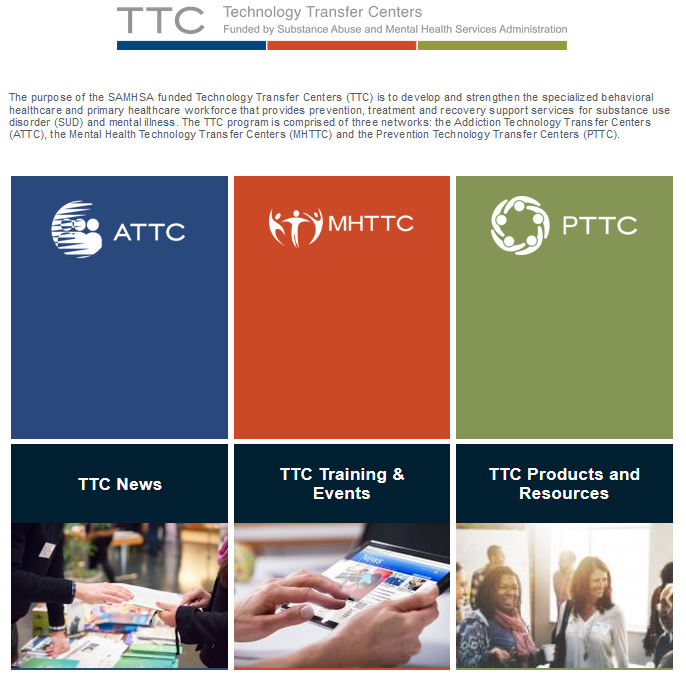
Please visit our sister Networks, the , and the . You can find us all, including searchable news, events, and products, at .
____________________________________________________________________________________________
SMI Adviser: Webinar Opportunities

SMI Adviser is a new initiative to improve care for individuals who have serious mental illness (SMI). The mission of SMI Adviser is to advance the use of a person-centered approach to care that ensures people who have serious mental illness find the treatment and support they need. SMI Adviser is completely free to use! Check out upcoming webinar opportunities below:
Digital Approaches to the Psychiatric Care of Older Adults
July 26, 2019
12:30-1:30pm ET
Learn about the latest evidence and hear case examples on how technology could advance clinical care for older adults who have serious mental illness (SMI).
Strategies for Successful Use of Clozapine: A Practical Guide
August 8, 2019
3-4pm ET Gain practical advice for prescribing鈥攊nitiation and titration, maintenance, side effect management, and prescriber resources.
Measurement-Based Care in Community Mental Health
August 16, 2019
12-1pm ET Review measurement-based care approaches for behavioral and physical health in the SMI populations.
Check out our website and make sure to follow us on social media!
It’s just another way to stay up to date with MHTTC Network news and more.
MHTTC Network
Contact us at networkoffice@mhttcnetwork.org
MHTTC Network Coordinating Office 路 Stanford University School of Medicine MC 5265 路 1520 Page Mill Rd 路 Palo Alto, CA 94304-1125 路USA
Thank you,
Dennis O. Romero, MA
Regional Administrator
Substance Abuse and Mental Health Services Administration (SAMHSA)
U.S. Department of Health and Human Services (DHHS) – DHHS Region II
Jacob Javits Federal Building
26 Federal Plaza, Suite 3337
黑料正能量, NY 10278
(212) 264-8097
Email: dennis.romero@samhsa.hhs.gov
Website: /1-877-726-4727