
黑料正能量 Note: Psychiatric advance directives can play a crucial role in ensuring that effective and engaging care is delivered to people with the most extensive mental health and substance use related conditions, especially during times of major crisis.
PADs give healthcare professionals the best information and direction available as to how to deliver the best crisis support from the best informants of all, the individuals themselves. They operate from the place of informed choice, as a powerful alternative to coercive approaches that could otherwise deliver care in an uninformed and potentially inappropriate or harmful manner that would discourage people to stay connected with services after the crisis.
The following piece provides details of specific successful examples of how PADs are being used. Note below how federal agencies like CMS are raising expectations that hospitals look for PADs and SAMHSA is developing strategies to promote their greater use.
Up to now, PADs are rarely understood or being used鈥�.yet their insertion into electronic healthcare records could make their use common someday soon.
See more about PADs at and contact our 黑料正能量 Training Collective at ruthcw@nyaprs.org to schedule a PAD training in your area.
Now Mental Health Patients Can Specify Their Care Before Hallucinations and Voices Overwhelm Them
Psychiatric advance directives allow patients with serious mental illness to specify the treatment they want if they become too sick to say so.
By 黑料正能量 Times December 3, 2018
CHARLOTTE, N.C. 鈥� Steve Singer, who has bipolar and borderline personality disorders, knows when he鈥檚 on the verge of a mental health crisis. The female voice he hears incessantly in his head suddenly shuts up, and the hula hoop he gyrates while walking to the grocery store stops easing his anxieties.
That鈥檚 when he gets to a hospital. Usually, talking briefly with a nurse or social worker calms him enough to return home. But this year a hospital placed him on a locked ward, took his phone, and had an armed guard watch him for 20 hours before a social worker spoke with him and released him.
鈥淚 get the heebie-jeebies thinking about it,鈥� said Mr. Singer, 60. 鈥淭hey didn鈥檛 help me, they hurt me.鈥�
Deeply upset, he turned to something he鈥檇 never known existed: He completed a psychiatric advance directive, a legal document declaring what treatment he does and doesn鈥檛 want. Increasingly, patients, advocates and doctors believe such directives (called PADs) could help transform the mental health system by allowing patients to shape their care even when they lose touch with reality. Hospitals must put them in patients鈥� medical records and doctors are expected to follow them unless they document that specific preferences aren鈥檛 in the patients鈥� best medical interest.
As the pendulum has swung from institutionalization to outpatient care, psychiatric directives also offer a middle path by allowing patients to designate family members to speak for them when they鈥檙e too sick to do so themselves.
But some doctors and hospitals are wary that the documents could tie their hands and discourage treatment they consider warranted. Some worry the directives won鈥檛 be updated to reflect medical advances. Others question whether people with serious psychiatric conditions are ever capable of lucidly completing such directives.
鈥淎 decision based on erroneous information on a PAD, that can happen,鈥� said Dr. Katayoun Tabrizi, a forensic psychiatrist at Duke. 鈥淭his is not a cookbook.鈥�
Still, early research and experience suggest that PADs, authorized by law , could help some of the millions of people with serious mental illness cope better and guide doctors treating them.
鈥淧ADs could be a very important tool to minimize hospitalization and minimize involuntary commitment,鈥� said Cherene Allen-Caraco, chief executive officer of Promise Resource Network, a peer-counseling organization in Charlotte. By letting patients give permission beforehand to be committed to hospitals they prefer, the directives can avoid the arduous court-ordered commitment process 鈥� traumatic for patients, especially if they鈥檙e handcuffed by police.
鈥淎nd by listing what鈥檚 been hurtful to you in the past and what鈥檚 been helpful to you, that could be an advantage to the treatment provider,鈥� Ms. Allen-Caraco said.
As people with serious mental illness cycle in and out of hospitals, many landing on the streets or in prison, better approaches are urgently needed.
Now, there are growing efforts to train counselors to help patients complete PADs and urge hospitals to honor them. The federal Centers for Medicare and Medicaid Services has strengthened advance directives, including psychiatric ones. The federal Substance Abuse and Mental Health Services Administration is considering ways to encourage directives. And PAD-completion clinics are emerging in Texas, North Carolina and elsewhere.
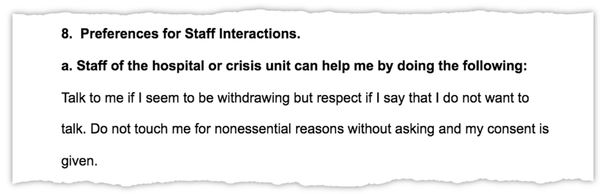
In the documents, patients specify treatments they like or despise; whether their crises involve suicidal feelings or hallucinations; even how to treat their service dogs and what doctors should say to penetrate their psychoses. Some patients carry copies, share them with relatives and their regular psychiatrists, and, when possible, register them in state databases.
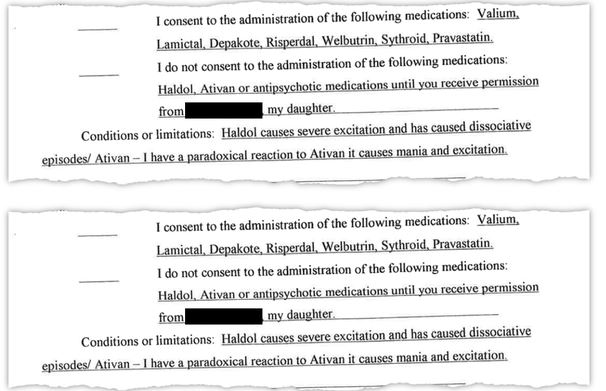
Mr. Singer鈥檚 lists his preferred hospital, five psychiatric medications he鈥檒l accept and two he won鈥檛 because they make him excitable. It says he rejects electroconvulsive shock therapy and refuses to be on a locked ward unless he or a trusted person says he intends to harm himself or others.
Dr. Marvin Swartz, a Duke psychiatry professor, said simply writing a directive increases some patients鈥� engagement in treatment, reducing setbacks with medication and therapy. After he and colleagues offered 239 patients the opportunity to complete PADs, they found .
Mr. Singer, a former X-ray technician, knows he sometimes needs inpatient hospitalization. He鈥檚 tried to kill himself three times: at 15 by hanging himself from a shower rod (it broke); in his 40s with his father鈥檚 World War II pistol (it jammed); and in 2012 with a shotgun (a pellet grazed his scalp and punctured the ceiling). After that attempt, he said he told a hospital, 鈥溾�業t was my Walmart shotgun or to you guys. I need somebody to put me behind a locked door.鈥欌��
Usually, though, he recognizes early symptoms, like his impulsive five-hour drive to a Johnny Appleseed statue in Virginia or a broken keychain that panicked him into thinking: 鈥淚鈥檓 going to lose my keys and get evicted and a meteor is going to strike,鈥� he said. 鈥淵ou鈥檝e heard of catastrophic thinking?
That鈥檚 for amateurs. I have apocalyptic thinking.鈥�
While briefly visiting a hospital stabilizes him, being confined there worsens his anxiety, he said. 鈥淚 don鈥檛 need anything that is going to move me one milli-scintilla in the shotgun direction and being locked up did a whole lot more than one milli-scintilla.鈥�
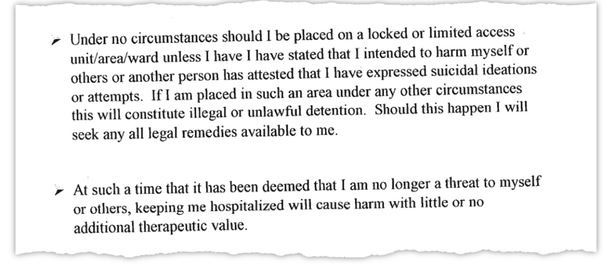
His directive lessens his concerns about seeking hospital help. On a chocolate-colored couch in his apartment, Mr. Singer, wearing an Alice-in-Wonderland T-shirt, said he鈥檚 been taking medication regularly and forgoing recreational drugs like mushrooms. 鈥淭hat psychiatric advance directive, I think is so important,鈥� he said. 鈥淚t allows me to turn things around.鈥�
Family can help
Ariel Wolf, 25, has been hospitalized 30 times since she was 13. She believes her PAD helped her get treatment that worked.
Ariel Wolf, 25, has been hospitalized over 30 times since age 13, when she began cutting herself with razor blades. Her brain directed her to inflict injuries meeting 鈥渃ertain dimensions of width and depth and location on my body,鈥� she said recently in a cafe near her home in Winston-Salem, accompanied by her service dog, Jubilee.
She鈥檇 slash her arms, elbows, shoulders and feet, photographing the wounds and sewing them up with fishing line. 鈥淏y the time I got to 5,000, I was sitting in the bathroom all night, obsessively cutting,鈥� she said. At 15, aiming to remove her appendix, she sliced a three-inch gash, stopping only when her mother came home.
At 17, during months of psychiatric hospitalization, Ms. Wolf, who has bipolar disorder with psychotic features, swallowed staples and shoved a paper clip into her thumb. But just before her birthday, she completed a directive, allowing her parents to participate in her care after she turned 18.
That helped save her, she said. Her parents communicated her directive鈥檚 preferences, including objections to electroconvulsive therapy and antipsychotic medications. Before having the document, she believes doctors sometimes considered her obstinate and forced treatment on her.
Even skeptics of PADs value that they let patients pre-authorize involvement of family or friends. In crises, patients might be too unstable or paranoid to give permission, said Victor Armstrong, a vice president for Atrium Health who runs Behavioral Health Charlotte, a 66-bed psychiatric facility.
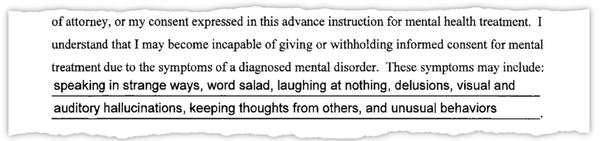
Ms. Wolf, now a mental health peer support specialist, said she no longer self-harms, but needs occasional hospitalization when experiencing symptoms like speaking in rhymes or hallucinating that light is stabbing her. Her recently revised directive indicates her parents aren鈥檛 needed as medical guardians but should be contacted. Its additional details include: 鈥淚 have a history of experiencing mania/hypomania in or around March, August, and sometimes November.鈥�
Obstacles to overcome
For PADs to become widespread, major logistical hurdles remain. Although hospitals are technically required to ask whether patients have advance directives, psychiatric directives aren鈥檛 yet common enough for hospitals to routinely embrace them. Until then, some patients won鈥檛 complete them, 鈥渁 chicken and egg problem,鈥� Dr. Swartz said.
Mr. Armstrong called PADs 鈥渁 wonderful notion鈥� that his hospital would try to follow, although they wouldn鈥檛 supersede doctors鈥� judgment or 鈥渙verride their fear of being sued.鈥�
Completing them requires detailed steps. In Charlotte, Judy Reiner said that because her 45-year-old son didn鈥檛 get his directive notarized, it wasn鈥檛 valid during a recent crisis and he endured involuntary commitment.
Many patients need extensive help writing directives, but proponents say psychiatrists and relatives shouldn鈥檛 assume that role because patients may suspect they just want to make hospitalization easier.
Effective PADs 鈥渨ould enhance people receiving appropriate treatment,鈥� said Dr. Mark Rapaport, chairman of psychiatry and behavioral sciences at Emory University. 鈥淏ut this is going to be really hard to do.鈥�
Ms. Allen-Caraco of Promise Resource Network, whose psychiatric diagnoses include major depressive disorder, said some patients are 鈥渁fraid of legal documents because they have been associated with removal of rights.鈥� At a PAD clinic, she provided helpers, witnesses, a notary and assistance registering PADs in the state database.
At the clinic, Bebe Smith, a clinical social worker, encouraged patients to be specific, but realistic: 鈥淚f you say, 鈥業 want to have milkshakes every day,鈥� that鈥檚 not a standard treatment.鈥�
She helped Lashawanda Ivey, who has schizoaffective and borderline personality disorders, complete a PAD. Ms. Ivey trembled as she recalled requesting hospitalization recently because 鈥� voices in my head were louder, and suicidal thoughts were coming.鈥� The hospitalization turned into 鈥渁n excruciating two days because people weren鈥檛 really listening to what I was saying.鈥�
Her PAD says hospitals shouldn鈥檛 鈥渙verload me with a whole lot of questions鈥� and that although she dislikes electroconvulsive shock, it鈥檚 helped her become communicative, so 鈥渋f they have to do it, yeah.鈥�
In another room, Harrison Pedigo, 26, got his directive witnessed and notarized. He wrote it in 2016, after four hospitalizations, beginning when his parents had him involuntarily committed because he was babbling, smearing paint on the carpet and walking barefoot in traffic. He said he hallucinated while hospitalized, including imagining he was telepathically communicating with a man wearing playing cards.
His PAD objects to three drugs and one hospital, and allows his parents鈥� involvement, preventing a recurrence of the time a hospital wouldn鈥檛 confirm he was there when his mother brought him clothes.
Since completing it, he hasn鈥檛 been hospitalized. He takes voice-over classes and lives with his parents in a townhouse decorated with his colorful abstract paintings. His directive is 鈥渁 safety net,鈥� he said, 鈥渢o help something not happen again or go smoother if it does.鈥�
Harrison Pedigo, at home with his parents, Leigh and Paul, suffers from schizophrenia and drafted a PAD in 2016 after four hospitalizations.CreditTravis Dove for The 黑料正能量 Times
A window into the human psyche
PADs can be Rosetta stones to a patient鈥檚 inner life.
鈥淪ometimes I hear voices that seem to come from another person鈥檚 brain,鈥� Andrew, a 29-year-old military veteran from Houston, wrote in his directive鈥檚 18 remarkably frank pages. 鈥淚 may find it helpful to think about obscure movies other people have probably not seen.鈥�
He listed 15 things that help deter him from quieting his demons with illegal drugs, including origami and playing catch. Conversation is good, wrote Andrew, who asked that his last name be withheld to protect family privacy. 鈥淏ut,鈥� he cautioned, 鈥渋t is very important that the attempt to converse does not include good-natured jesting, joking or hazing.鈥�
鈥淪ometimes I think that people are not who they say they are,鈥� he advised. 鈥淧lease let me know you are real by saying things like: 鈥榃e drove here. We did not warp here.鈥欌��
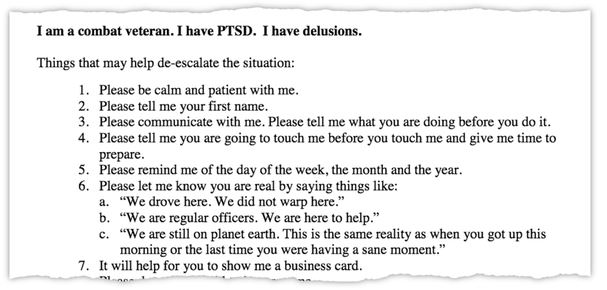
Laurie Hallmark, managing attorney for mental health programs at Texas RioGrande Legal Aid, who helped Andrew draft his directive, said that recently, when he was hospitalized and completely inside psychosis,鈥� a nurse followed his PAD, essentially saying 鈥溾�極h wow! I recognize these behaviors.鈥欌�� 鈥�
Andrew鈥檚 directive includes small steps to defuse big crises.
鈥淭hings that may help me to not want to kill myself,鈥� Andrew listed. Among them: drinking Yogi tea and discussing a concept called 鈥渋nfinite replay鈥� 鈥� although he added, 鈥淚 understand that other people may not find this topic fascinating.鈥�
In emergencies, before hospitals use medications, seclusion or restraint, Andrew implores them to try other approaches.
鈥淧lease,鈥� he wrote, describing one, 鈥渟ay 鈥業t鈥檚 going to be ok.鈥欌��